Is my rational faith in reason as the best path to truth unfounded simply because I myself am fallible? Even if I am sometimes irrational, or unreasonable, does that undermine the argument that reason is sacred? If reason is not essential to our human nature, if it is not what is essential to separate human being from all other animals, then I've been wrong all along. Even if on average, 'human nature' is basically animal nature, and the group consciousness we call democracy is subject to the vagaries of inter-subjective irrational behaviors, does that make it wrong to hold reason itself as sacred? If we fail to hold reason as the goal, as the ultimate form for which we strive, even if we are individually incompetent and only barley adequate in groups using the scientific method, then we give up on our humanism and our freedom of will. If so, we will revert to tribalism, to religion, to the darkness before the enlightenment, and we will kill our planet and its species of life by nuclear war. If social psychologist Jonathan Haidt is right, and our 'human (animal, social) nature is evolved to support war, and yet our rational consciousness is unable to reflect upon itself and adapt to the new technological reality, then we and our planet are doomed to Armageddon. The definition of heroism is to strive in the face of certain doom. Even Haidt would admit that the irrational hope that stems from our belief in our individual ability to achieve far beyond what we should reasonably expect is what gives us the psychological edge to attempt the impossible, so our goal must be to ignore the 'facts' of his social psychology and create a form of social cognitive-dissonance that ignores the cynicism, the data, and seeks to transcend our very nature and achieve the epic win, freeing ourselves from the matrix individually, and ultimately as a species. Perhaps this means evolving socially away from traditional cultures of religious fundamentalism and conservative foolishness, or just building technological safeguards and safety nets to avoid extinction. The war has begun.
Both liberals and conservatives may be insane, but liberals are less insane, because their moral views are based in rational consequences of human action rather than a supernatural religious jingoism. Liberals are crazy, but conservatives are crazy and blind.
Wednesday, February 29, 2012
Bill Moers always makes me question myself


Saturday, January 07, 2012
Magnetic Generators
Magnetic Generator To Power Your Home - Lutec Australian Proprietary Limited, Patented Model, Six-Times energy out as energy in (1250 volts out vs. 210 volts in)? Claims energy is amplified by a factor of five (20% input = 100% output, i.e. 80% free energy)? Said that they had been on a 10 year journey in 2008, and they were raising money from 'sophisticated' investors to put them on the market by 2010. They seem to be just an electric motor spinning up a balanced magnet, perhaps with gearing. What is odd is that you have to put 'energy in' constantly. If it makes more energy than it uses, then surely you could store the output in a battery for a while, then use that batter to supply the input, thus creating a perpetual motion machine. Also it seems to be working in a disk but not a vacuum.
MAGNET MOTOR L ENERGIA INFINITA GRATIS ESISTE!!!!LEGGI !! - this is a basic magnetic ramp, doesn't seem to accelerate perceptibly.
Bedini's gates - this is an example of a balanced magnet, similar to the one I first built in 2003. Here is another example of a Zero PMG that fails in English.
http://youtu.be/0D_qdbLmxqk
Magnetic Motor, Free Energy Test 1 - this is one of the first YouTube videos I came across testing the same concept, note that this uses a balanced magnetic wheel, so it doesn't generate energy. Hover this demonstrates the same learning curve I was on.
This guy actually goes through multiple models on YouTube:
- Magnet motor, free energy, overunity test 2
- Free Energy Green power Overunity Test 3 - here he seems to move to a asymmetrical magnetic ramp and get some success, because the system is no longer balanced, but there is no audio.
- 3rd generation, 2nd model Overunity FREE ENERGY green power
- FREE ENERGY MOTOR CATCHES ON FIRE! - here the machine is hooked to a battery that runs it, and he uses a home made switch presumably for switching the polarity of an external electro-magnet, but I can't seem to figure out how he intends to get energy out?
- Free energy motor test 5
Here are a couple of examples of small toy magnetic-cone motors.
a) selfrunning working permanent magnet motor
b) V Gate Perpetual Motion Toy - this is a computer model from JKGdesign.co.uk
Then there are a series of VGATE motors that inspired my design.
VGATE#04a - I can't tell if there is much accelleration from the magnets or how the target is aligned, but it seems to be more than the energy from the finger push, so why does he stop it from spinning each revolution?
V-GATE#05d_Test01 - this Austrian engineer, Dietmar Hohl, is building heavy quality gear. Doing a lot of work on his Stratoplatte, with 12mm gap, so why does it stop every rotations? MagnetMotor.at
MAGNETMOTOR DMT-01a - all his designs seem unbalanced and forced. He can't seem to stop touching them every turn.
-------------------------------------------------
Interviews with John Searl
Searl Electric Generator - (anti gravity?)
This computer model of a Seral Effect Generator is a more advanced Magnetic Generator apparently using electromagnetic coils wrapped around various circular permanent magnets in a pattern. I am unsure how it produces any electric energy or force since it seems balanced. Note Links: SeralEffect.com SearlSolution.com SwallowCommand.com
Here is another Searl Video - where the SEG Technology is explained.
According to the information I can find online, the machine somehow uses scaler waves and guage energy to induce electomagnetic phase conjugation in a combination diode/transformer with a monopole magnet set that somehow self powers using the Lorenz Force (Right Hand Rule) like a Faraday Disk, and this pattern can be nested to increase power, as boson pairs of electron waves are emitted. The 'Hull Effect' and magnetic bearings are used to create a set of magnetic gears floating upon the eddy currents. This system somehow converts random quantum energy of the ambient environment, the machine itself is cooled, as chaotic patterns are captured unified and ordered automatically by the device. The temperature energy is turned into the ordered movement of electrons (i.e. electricity). Once the machine super-cools it becomes a superconductor, and this changes its properties in respect to the gravitational field, effectively reducing its inertia, and perhaps creating a field around it that somehow acts as inverse gravity (anti-gravity)? It is not clear weather the superconductive machine actually produces an anti-gravity field, or simply negates the existing gravity field?
Searl was an untrained scientist, nearly deaf from birth, he had learning disabilities but was apprenticed at age 14 as an electrical engineer, and may have independently developed a form of matrix algebra, and applied it to physical relationships such as magnetic fields. At 83 years old he seems to have forgotten how to build his device, but is working with others to re-discover it. To those who say you can't get energy from the ether, due to the second law of thermodynamics, John replies simply, that works only in a closed system, but this is an open system. Among some of the interesting concepts is the explanation of magnetism as a twist in two dimensions of space, and of light as electron-waves at an angle. Light (EM waves) and Magnetism are two parts of the same energy, so we might somehow separate magnetic fields into 'wavelengths' the same way we polarize light through a crystal to make a laser. It seems plausible that that a series of magnetic fields might organize quantum energy, shifting its phase and transforming it, or organizing it into a train of electrons, thus supercooling one thing to provide electric current to another. And the effects of superconducting materials are not well understood, the fourth state of matter has strange properties, and quantum effects at the macro scale might take effect?
Friday, January 06, 2012
Tesla's Little Secret
Also, he says Russell Athletic was founded in 1902?
Friday, December 23, 2011
Wondering who will see the history if it is erased?
- The Yes Men Change the World
- War by Other Means - a prescient video about the IMF from 1993
- Zeitgeist: Moving Forward
- The Corporation
- Golden Rule: The Investment Theory of Politics
- Capitalism IS the Crisis: Radical Politics in the Age of Austerity
- Inside Job
- Capitalism: A Love Story
- Lifting the Veil: Obama and the Failure of Capitalist Democracy
- Rise Like Lions: O.W.S. and the Seeds of Revolution
- The Secret of Oz
Monday, November 28, 2011
On MIRTH
"The sense of humor is a ubiquitous human trait, yet rare or non-existent in the rest of the animal kingdom. But why do humans have a sense of humor in the first place? Cognitive scientist (and former programmer) Matthew Hurley says humor (or mirth, in research-speak) is intimately linked to thinking and is a critical task in human cognition because a sense of humor keeps our brains alert for the gaps between our quick-fire assumptions and reality. 'We think the pleasure of humor, the emotion of mirth, is the brain's reward for discovering its mistaken inferences,' says Hurley, co-author of Inside Jokes: Using Humor to Reverse-Engineer the Mind. With humor, the brain doesn't just discover a false inference — it almost simultaneously recovers and corrects itself. For example, read the gag that's been voted the most consistently funny joke in the world by a global audience. So why is this joke funny? Because it is misleading, containing a small, faulty assumption that opens the door to a costly mistake.Humor is 'when you catch yourself in an error, like looking for the glasses that happen to be on the top of your head. You've made an assumption about the state of the world, and you're behaving based on that assumption, but that assumption doesn't hold at all, and you get a little chuckle.'"
Wednesday, September 28, 2011
Solar Power Shines In San Antonio As Texas Green Movement Gains Momentum
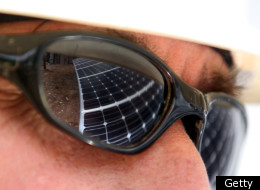
Poor Al Ritter: "I expected I would've had a bill that was over $300 for the month for electric power," Ritter told The Huffington Post. Instead, he said, his most recent bill came to $252 -- a savings he attributes to the array of 24 solar panels the Ritters had installed on their roof in August.
Like all people in TX, Ritter is used to wasting cheap carbon energy - his home wastes about 7200 Kw per month just trying to cool the 100 degree air. He built an a $30,000 PV Array on his roof, without insulating and air sealing his home. Now he gets about $60 off his energy bill each month.
If someone honest had sold him the solar panels, they would have required a home energy audit first, and that independen
$150/month X 12 = $1,800 / year on $10,000 -- >R.O.I. = 18% / year (FOREVER!)
$60/month X 12 = only $720 / year on $30,000 --> R.O.I. Just 2% / year (For 20-30 years)
Solar isn't a bad idea, but without first reducing you energy waste, it just doesn't work.
If Solar Installers keep doing this kind of bad business, they will kill their own industry as people wake up.
Read the Article at HuffingtonPost
Friday, September 23, 2011
A marshmallow for your thoughts?
Read more at the New Yorker
Once Mischel began analyzing the results, he noticed that low delayers, the children who rang the bell quickly, seemed more likely to have behavioral problems, both in school and at home. They got lower S.A.T. scores. They struggled in stressful situations, often had trouble paying attention, and found it difficult to maintain friendships. The child who could wait fifteen minutes had an S.A.T. score that was, on average, two hundred and ten points higher than that of the kid who could wait only thirty seconds.The scientists are hoping to identify the particular brain regions that allow some people to delay gratification and control their temper. They’re also conducting a variety of genetic tests, as they search for the hereditary characteristics that influence the ability to wait for a second marshmallow.
“What we’re really measuring with the marshmallows isn’t will power or self-control,” Mischel says. “It’s much more important than that. This task forces kids to find a way to make the situation work for them. They want the second marshmallow, but how can they get it? We can’t control the world, but we can control how we think about it.”
Brain Imaging
Gallant Lab website, with more details about the study
It seems via computer analysis and study of individual brain response to visual stimuli we can reconstruct a proximity of what the is in the minds eye. Many hurdles stand in the way of mind reading, not the least of which is that success requires years of brain scans while watching known video sources, and the tracking is done by blood volume rather than neuro-electrical signals, but the concept is still cool.
Read the Article from Berkley
Sunday, August 21, 2011
The Morality of Liberals Vs. Conservatives
The Myth of Violence
It is my understanding that our brains ability to reason evolved quickly over the last 100,000 years because of constant culling of people through the process of WAR. We are the animal that, like most top predators, has evolved through competition with our own kind. Everyone alive today owes their mental ability to the violence of our ancestors. The question, then, is not why are people violent, but why not?
- Hobbes - The Laviathen - Anarchy = Violence :: Government = Peace; Mutually Assured Destruction: Shoot him before he shoots me.
- Payne - Life is cheap - Technology = Life
- Robert Right - Non-Zero Sum Games - Win-Win = Value
- Peter Singer - Empathy : Friends and Family - Expanding Circle, village, clan, tribe, nation, sexes, species ...
Wednesday, August 03, 2011
Listening
Most people are entirely unconscious to these filters, they don't recognize that they hold bias when they listen.
- Culture
- Language
- Values
- Beliefs
- Attitudes
- Expectations
- Intentions
A world where we don't listen to each other at all is a very scary place indeed.
5 -tools:
1) Silence (3-minutes/day)
2) Mixer (go to a noisy place, and figure out how many channels)
3) Savoring (pick a mundane sound and really listen to it)
4) Listening Positions (active/passive, reductive/expansive, CRITICAL/Empathic)
5) RASA - Receive, Appreciate, Summarize, Ask
Every Human Being has to Listen Consciously,
Listening needs to be taught in schools as a skill.
Wednesday, July 20, 2011
If Corporations are People, then People are Corporations
Monday, July 11, 2011
Zeitgeist Movement Activist and Orientation Guide
PREFACE:
The Zeitgeist Movement is the activist arm of The Venus Project, which constitutes the life long work
of industrial designer and social engineer, Jacque Fresco. Jacque currently lives in Venus, Florida,
working closely with his associate, Roxanne Meadows. Now, let it be understood that Mr. Fresco will
be the first to tell you that his perspectives and developments are not entirely his own, but rather
uniquely derived from the evolution of scientific inquiry which has persevered since the dawn of
antiquity. Simply put, what The Venus Project represents and what The Zeitgeist Movement hence
condones, could be summarized as: ‘The application of The Scientific Method for social concern.’
Through the humane application of Science and Technology to social design and decision-making,
we have the means to transform our tribalistic, scarcity driven, corruption filled environment into
something exceedingly more organized, balanced, humane, sustainable and productive. To do so, we
have to understand who we are, where we are, what we have, what we want, and how we are going to
obtain our goals. Given the current state of affairs, many of which will be addressed in the first part
of this book, the reader should find that we not only need to move in another direction...we have to.
The current economic system is falling apart at an accelerating rate, with the prospect of worldwide
unemployment occurring on the largest scale ever seen. Simultaneously, we are courting the “point of
no return” in regard to the destruction of the environment.
Our current methods of social conduct have proven to have no chance in resolving the problems of
environmental destruction, human conflict, poverty, corruption and any other issue that reduces the
possibility of collective human sustainability on our planet. It is time we grow up as a species and
really examine what the true problems and solutions are, as uncomfortable, untraditional and foreign
as they might seem.
This work will first present the current economic problems we face, recognizing root causes,
consequences and inevitabilities, while then presenting solutions derived from an assessment of what
is actually relevant to life and society. Additionally, information will be provided as to how each one
of us can help in this challenge, presenting methods of communication and activism that will
hopefully speed up the process of transformation.
It is very important that those who begin this work pause for a moment and think about the
windows of perspective they have been indoctrinated into. Considering the current vastness of human
values and ideologies, coupled with the identification that grows over time with associations to a
particular train of thought, tradition or notion of reality, it can be difficult and even painful for a
person to revise or remove the cherished understandings which they have considered true for long
periods of time. This ‘ego’ association, coupled with the perpetual state of ‘limited knowledge’ each
one of us has, will be the biggest hurdle many will face when reading the information presented here.
It is time to broaden our loyalties and affiliations beyond the narrow confines of the marketplace,
tradition, and the nation-state to encompass the human species as a whole, along with the planetary
environment that supports us all. It is time we view the earth as an indivisible organic whole, a living
entity composed of countless forms of life, all brought together in a single community.
If nature has taught us only one thing, it is that the only constant is change. There is no such thing
as a Utopia. Therefore, in order for us to grow productively as a species, we need to become experts
at “changing our minds” about anything and everything. If you choose to approach this material with
a conscious attempt at being open minded and objective, we feel the ideas expressed here will realign
your vision of the world, yourself, and the future of our human family in a way that is the most
productive, humane and effective.
Monday, June 27, 2011
"Zero Point" - Free Energy
Free-energy devices (from Wikipedia)- a new twist on a long list of perpetual motion machines
As a scientific concept, the existence of zero-point energy is not controversial although the ability to harness it is. In particular, perpetual motion machines and other power generating devices supposedly based on zero-point energy are highly controversial and, in many cases, in violation of some of the fundamental laws of physics.[citation needed] No device claimed to operate using zero-point energy has been demonstrated to operate as claimed. No plausible description of a device drawing useful power from a source of zero-point energy has been given. Thus, current claims to zero-point-energy-based power generation systems have the status of pseudoscience.[9]The discovery of zero-point energy did not alter the implausibility of perpetual motion machines. Much attention has been given to reputable science suggesting that zero-point-energy density is infinite, but in quantum theory, zero-point energy is a minimum energy below which a thermodynamic system can never go. Thus according to the standard quantum-theoretic viewpoint, none of this energy can be withdrawn without altering the system to a different form in which the system has a lower zero-point energy. However, in Stochastic Electrodynamics, the zero-point field is viewed as simply a classical background isotropic noise wave field which excites all systems present in the vacuum and thus is responsible for their minimum-energy or "ground" states. The requirement of Lorentz invariance at a statistical level then implies that the energy density spectrum must increase with the third power of frequency, implying infinite energy density when integrated over all frequencies.[10] In this viewpoint, there is no theoretical reason that energy, or for that matter, momentum, could not be extracted, and would of course still leave infinite energy density and infinite momentum density, isotropic in all directions simultaneously, remaining in the wave field.
The calculation that underlies the Casimir experiment, a calculation based on the formula predicting infinite vacuum energy, shows the zero-point energy of a system consisting of a vacuum between two plates will decrease at a finite rate as the two plates are drawn together. The vacuum energies are predicted to be infinite, but the changes are predicted to be finite. Casimir combined the projected rate of change in zero-point energy with the principle of conservation of energy to predict a force on the plates. The predicted force, which is very small and was experimentally measured to be within 5% of its predicted value, is finite.[11] Even though the zero-point energy is theoretically infinite, there is as yet no practical evidence to suggest that infinite amounts of zero-point energy are available for use, that zero-point energy can be withdrawn for free, or that zero-point energy can be used in violation of conservation of energy.[12]
Wednesday, June 22, 2011
CNN & Michio Kaku Report : Japanese officials lie about Fukushima Meltdown
Pay attention, Fukushima is FUBAR! Watch world rebound Japanese-American Physicist, Michio Kaku, embarrass the Japanese Utilities and Government, on CNN Reports.
Tuesday, June 21, 2011
Wednesday, June 15, 2011
Monday, May 16, 2011
Saturday, April 30, 2011
Thursday, April 21, 2011
Gravity may not exist any more than matter.
Tuesday, April 19, 2011
Marcin Jakubowski: Open-sourced blueprints for civilization
How do you get someone to be self-sufficient? Teach them to fish, farm, or work. Independence comes from interdependence, not codependency. Open source hardware from Marcin Jakubowski, Polish Nuclear Fusion Expert and 21st Century Organic Farmer.
Monday, April 18, 2011
New Bicycle Discovery
New Bike Stability Discovery! No Gyro, No Castor. Bicycles steer into their fall. (To prove try pushing a bike backwards, or locking handlebars)
Thursday, April 14, 2011
Jamie Oliver's Food Revolution = LAUSD
NEVER EAT GROUND BEEF UNLESS YOU GRIND IT YOURSELF!
Monday, April 11, 2011
Caroline Casey: Looking past limits
Born with Ocular Albinism which limits what she can see beyond 1-meter, Caroline Casey was never told she couldn't see. Irrational Faith in oneself may be necessary to reach your full potential. Such belief in oneself inspires actions that one would not attempt from an attitude of self-pity. Society may be artificially limiting the potential of physically disabled people (1-billion world wide) via labeling. Solution: expect the same level of accomplishment from everyone, regardless of any 'dis-ability', and don't discriminate. (my question here is if everyone had Ocular Albinism would we create technology to adapt our eyes, just as elephants have larger ears and noses, or would we evolve better eyes?)
Thursday, April 07, 2011
The Primary Dealer Credit Facility = $9-Trillion+
http://money.cnn.com/2010/12/01/news/economy/fed_reserve_data_release/index.htm
http://projects.propublica.org/tables/treasury-facilities-loans
Saturday, March 26, 2011
Coldfusion, The Nuclear Effect
- Cold Fusion - Bologna - "journal of nuclear physics" (i.e. real or false journalism) - The nuclear effect
- Zero-Point - Motionless EM Generator - Electric Multiplier
- Perpetual Motion - Scalar Energy Device - Radiant-Energy Fractionation (static electric charge) - Mechanical Heater - resonant frequency electrolysis - implosion/vortex engines - permanent magnet powered motors -
- Batteries -
- greedy con men, and "hermit scientists" - name the game
- Transportation Solutions -
(Please use the comments section to add your own comments, suggestions, and links. Thanks.)
Thursday, March 10, 2011
Global Classroom
I don't do this often, but this is a special case. When someone states the obvious truth, it cuts across all lines, and I must post it everywhere.
"If Issac Newton had done calculus videos on YouTube, I wouldn't have to. (assuming he was any good) - Salman Khan"Why do good students fail in our public schools?
Traditional Classroom Model penalizes you for experimentation and failure, "DO YOU UNDERSTAND THIS?". Kids COMPETE with each other, but does not expect mastery.
Assign the lectures as homework, and do the homework in the classroom.
Pause, work at your own pace. Stay on that bicycle, experiment, failure is OK. Reward success, don't penalize failure. Allow students to COOPERATE, and you will see that your 'slow' students are just as smart as the 'gifted' kids.
But expect mastery.
Build a Global, One World Classroom.
Sunday, January 16, 2011
Martin Luther King, Jr.: "I Have a Dream...to Go to War?!"
Why is it that Citizen Activists from Robert Greenwald's BRAVE NEW FILMS are the only people making media against the Afghanistan War? (pissst ... DO SOMETHING!)
Each Citizen Activists has the ability to:
- Challenge corporate media with TRUTH.
- Share the latest videos from Brave New Films.
- Give input on projects that are in development.
- MAKE A DIFFERENCE!
Please "LIKE" them on FaceBook
Monday, January 03, 2011
Practical Philosophy: Aristotle's Telos
Practical Wisdom is the will and the skill.
You must have the Value and the Creativity.
If you want to do right, and you are creative enough to find a way, then you have practical wisdom.
Barry Schwartz studies the link between economics and psychology, offering startling insights into modern life. Lately, working with Ken Sharpe, he's studying wisdom. In an intimate talk, Barry Schwartz dives into the question "How do we do the right thing?" With help from collaborator Kenneth Sharpe, he shares stories that illustrate the difference between following the rules and truly choosing wisely.
Right Action - Requires Experience
Right Way - Requires Empathy
Right Aims (or Reasons) - Requires Failure
"You do not need to be brilliant to be wise, but brilliance without wisdom is dangerous."
There are "Canny Outlaws" who can work within the system that seeks to destroy them, but we need "System Changers", who can step outside the system and change the game with Practical Wisdom. All social interaction is moral action.
Saturday, December 18, 2010
Crazy is a social definition.
Narcissism is so common today that they have stopped calling it a mental illness, proving that Psychology is not an objective science but a subjective language subject to the influence of political "correctness". This reminds me of 1994, when the DSM-IV came out and changed the diagnosis of people who believe in supernatural beings (like ghosts and angels, demons and gods) from Axis-I (psychotic disorder) to Axis-IV (psychosocial and environmental problems) i.e. "cultural dissassocition with reality". That was the same year that they added "Post Traumatic Stress Syndrome" and removed "Homosexuality" as mental disorders. Thus, the Diagnostic and Statistical Manual is nothing more than a strange mix of social values, political compromise, and material for insurance claims. Psychological Medicine is not a science. "Crazy" is a social definition.
Monday, September 27, 2010
Bill Gates- Question's Making Money
How we allocate intellectual resources matters to the survival of the species.
Three Albino Boys from China
Chosen ones from preston gannaway on Vimeo.
In China, children with albinism face a bleak future. Often abandoned and ostracized, most will never be educated, marry or find a job in their country. Adoption offers hope for a chosen few.
Kim Anderson was facing an empty nest and looking for a way to do more to serve God when a photo of a Chinese orphan caught her eye. "That's our child," she thought. Now eight years later, Kim and her husband, Steve, have adopted four special needs children. The three boys have albinism.
Ironically, the same rare condition that stigmatized the boys individually in China, reinforces their brotherhood in the United States. Elijah, Paul and Micah's snow white hair and pigmentless skin, create the appearance of a biological connection. Despite their age difference, people often mistake them for triplets. What may be shocking and novel on one child is normalizing on all three.
Saturday, July 24, 2010
The Secrets Next Door
"These are some of the most brilliant people in the world," said Ken Ulman, executive of Howard County, one of six counties in NSA's geographic sphere of influence. "They demand good schools and a high quality of life."
The schools, indeed, are among the best, and some are adopting a curriculum this fall that will teach students as young as 10 what kind of lifestyle it takes to get a security clearance and what kind of behavior would disqualify them.
The buses deliver children to neighborhoods that are among the wealthiest in the country; affluence is another attribute of Top Secret America. Six of the 10 richest counties in the United States, according to Census Bureau data, are in these clusters.
Loudoun County, ranked as the wealthiest county in the country, helps supply the workforce of the nearby National Reconnaissance Office headquarters, which manages spy satellites. Fairfax County, the second-wealthiest, is home to the NRO, the CIA and the Office of the Director of National Intelligence. Arlington County, ranked ninth, hosts the Pentagon and major intelligence agencies. Montgomery County, ranked 10th, is home to the National Geospatial-Intelligence Agency. And Howard County, ranked third, is home to 8,000 NSA employees.
The building, sealed off behind fencing and Jersey barriers, is larger than a football field. It has no identifying sign. It does have an address, but Google Maps doesn't recognize it. Type it in, and another address is displayed, every time. "6700," it says.
No street name.
Lane, senior vice president of Ryan Commercial real estate, has become something of a snoop himself when it comes to the NSA. At 55, he has lived and worked in its shadow all his life and has schooled himself on its growing presence in his community. He collects business intelligence using his own network of informants, executives like himself hoping to making a killing off an organization many of his neighbors don't know a thing about.
He notices when the NSA or a different secretive government organization leases another building, hires more contractors and expands its outreach to the local business community. He's been following construction projects, job migrations, corporate moves. He knows that local planners are estimating that 10,000 more jobs will come with an expanded NSA and an additional 52,000 from other intelligence units moving to the Fort Meade post.
Lane was up on all the gossip months before it was announced that the next giant military command, U.S. Cyber Command, would be run by the same four-star general who heads the NSA. "This whole cyber thing is going to be big," he says. "A cyber command could eat up all the building inventory out there."
"I can spot them," she says. The suit. The haircut. The demeanor. "They have a haunted look, like they're afraid someone is going to ask them something about themselves." Undercover agents come in here, too, she whispers, to watch the same people, "to make sure no one is saying too much."
Burns would know - she's been living with one of those secretive men for 20 years. He used to work at the NSA. Now he's one of its contractors. He's been to war. She doesn't know where. He does something important. She doesn't know what.
And inside the NSA, the mathematicians, the linguists, the techies and the crippies are flowing in and out. The ones leaving descend in elevators to the first floor. Each is carrying a plastic bar-coded box. Inside is a door key that rattles as they walk. To those who work here, it's the sound of a shift change.
It is nice to know that "Defense and Intelligence" contractors have access to 3D models of our nations capital cities for surveillance, to "keep us safe". When we have the "smart" people all locked up, unable to communicate with others, and a perpetual motion machine of hardened private corporations and government agencies, all competing for the unending stream of money, you begin to wonder, what the hell were they thinking? What kind of world are they making?
Wednesday, July 21, 2010
Inception, the danger of Lucid Dreaming, and effects on Reality
It is important to note that Lucid Dreaming is very dangerous. Most people don't remember most of their dreams, and there is good reason for this. While we sleep, our brains are not just resting, they are re-tooling, laying down new growth by expanding neurons, and eliminating unused paths that are taking space and energy. Chemicals are infused into our brain when we are asleep to detach our body, otherwise we would sleep walk, or worse. Imagine what would happen if you lived in a tenth floor apartment and had a lucid dream that you could defy gravity? But that's not the real danger. Dreams take real world experiences from our memories and re-run them over and over to strengthen our memory, and workout any problems or lapses in understanding. To do that the dreams go to the extremes of the possible, and beyond, to test every possible outcome of our real world experience. If you didn't forget your dream upon waking, you would remember these impossible scenarios as if they were real memories. This would lead to magical thinking, and what some call 'divine experience'. It is this creating of false memories that plagues some with sleep disorders, just as the sleep deprived have memory problems from forgetfulness, those who loose the ability to distinguish dreams and reality risk not just the accuracy of their memory, but their ability to make rational choices.
Practiced responsibly by a mature mind, Lucid Dreaming ( http://en.wikipedia.org/wiki/Lucid_dream ) can spur creativity and solutions to problems. Practiced without discipline and understanding it leads to the destruction of society via all forms of insanity.
It is my personal theory that the vast increase in psychotropic prescription drugs in the USA has lead to such mental breakdown in a large part of the society. When added to poor diet, alcohol, tobacco use, and illicit drug taking, this has hampered the ability of Americans to make rational decisions in the public political and economic areas.
Read the Article at HuffingtonPost
Sunday, July 18, 2010
Make a Point, Not a Profit
"It is NOT the business of The Progressive to stay in business, it is the business of The Progressive to Change the World" - Irwin Noel, Editor of 'The Progressive' Magazine 1968, after being threatened by the US Government for publishing an issue on how to create an Atomic Bomb, based entirely upon public sources.How many modern media outlets would have that kind of courage? To print the truth, regardless of the effect upon your journal, even and up to its destruction (much less, its pocketbook), is the ultimate test of journalism.
If you believe these words, and live in San Diego, CA, then go to the San Diego Society for Media Justice, and send us a note.
Saturday, July 10, 2010
Plato's hidden Music in the Republic
Q: Combine Math and Religion, and what do you get?
A: Music.
It sounds like something out of a Dan Brown novel, but a scholar in Manchester, England, claims to have found hidden code in the ancient writings of Plato. If true, the secret messages would have made the ancient philosopher and mathematician a heretic in his day.
Jay Kennedy tells NPR's Guy Raz that his discovery was partially luck. Looking at Plato's works in their original scroll form, he noticed that every 12 lines there was a passage that discussed music. "The regularity of that pattern was supposed to be noticed by Plato's readers," Kennedy says.
Music in ancient Greece was based on a 12-note scale, unlike the eight-note scale of modern Western music. Kennedy posits that Plato deliberately inserted discussions of music every 12 lines to send a secret, musical message.
What Plato couldn't tell people was that he was a closet Pythagorean. Pythagoras and his followers believed that mathematics and music were the key to the universe.
"The Pythagoreans realized that when we hear beauty and music, when we hear notes harmonizing, that's because the notes have simple ratios, like 1:2 or 3:4," Kennedy explains. "So the beauty of music is direct perception of the mathematical order underlying the world. They worshipped that mathematics."
But the Pythagoreans were a persecuted sect, Kennedy adds, sometimes violently persecuted. "They were a threat to traditional religion, like many new sects." Plato's own teacher, Socrates, was famously executed for religious heresy.
"Simply put, they were threatening to overthrow the gods on Olympus and put numbers and mathematics in its place. Prior to Socrates being executed, a number of other philosophers were banished or fled because of threats to themselves. It was dangerous in those days to be a philosopher."
As far as Kennedy can tell, Plato's message was one of solidarity simply by acknowledging the relationship between music and mathematics, but he suspects there's more to it. "Perhaps some scholar will find that — in The Republic, at least — that there is something like a melody or a score embedded in the text," he says.
If that's true, then we've read only half of Plato's writings. "There are all these hidden layers of meaning which will enrich our understanding of Plato," Kennedy says. And maybe what else Plato has to say could help us today.
"Plato's philosophy shows us one way to combine science and religion," Kennedy says. "The culture wars we're having today — about evolution for example — see science and religion as two polarized opposites. Plato's hidden philosophy shows us that he combined an emphasis on mathematics with an emphasis upon beauty, music, art and divinity. The founder of western culture, in fact wanted us to combine science and religion." - from NPR
Tuesday, June 15, 2010
Patternicity: by Michael Shermer
Tuesday, May 18, 2010
Sunday, April 18, 2010
The Sleeper Awakens
 For Sidhartha moving through the cycle of the wheel of life and death was suffering, and only finding the center, understanding the oneness of everything can lead to enlightenment.
 - Life is suffering
- The origin of this suffering is our attachment
- The cessation of suffering is attainable
- The path to the cessation of suffering - is in finding balance through the 8 fold way:
- Right View - to understand things as they really are, in flux and temporary
- Right Intention - commit to positive change in oneself, ethical action, eternal curiosity and compassion
- Right Speech - tell the truth, be respectful, warm, and gentle and talk only when necessary
- Right Action - abstain from harming sentient beings
- Right Livelihood - one should earn one's living in a righteous way
- Right Effort - in order to gain anything you must first loose everything
- Right Mindfulness - consciousness, awareness anchored in clear perception: four foundations of mindfulness: 1. contemplation of the body, 2. contemplation of feeling (repulsive, attractive, or neutral), 3. contemplation of the state of mind, and 4. contemplation of the phenomena.
- Right Concentration - state where all mental faculties are unified and directed onto one particular object, emotion, action, concept, idea, or being. Living in the present moment.
Monday, March 29, 2010
For California Citizens
However, Prop.13 affects ALL property, including second homes, investment property, and commercial property, and our state government is facing bankruptcy from underfunding. SHELL CORPORATIONS created as holding companies for commercial real-estate are responsible.
Homeowners sell their homes on average ever 5-7 years, even elderly homeowners die every 30-50 years, but CORPORATIONS NEVER DIE!
Under Prop.13, I can form a corporation, buy a property, live in that property, write off all costs of that property as "business expenses", and never have that property re-assessed for tax purposes.
When I'm tired of that property, or the property value has increased enough that I want to sell it and enjoy the equity, then I can simply sell the HOLDING CORPORATION. The property never technically changes hands, and is thus never re-assessed for tax purposes. The new owners simply keep the tax protection of Prop.13.
If I die, the corporation is passed to my heirs, without any loss of tax protection. And CORPORATIONS LIVE FOREVER.
Paying 1% on the value of Capital Investments is not extreme, it is the cost of government, the cost of schools, hospitals, libraries, roads, and other vital government services.
If your business can't afford to pay 1% property taxes, then it isn't a very good business, sell the property, and let someone else have the chance to make it work for them.
Split the Roll, stop the Property Tax Loophole for Corporations.
CORPORATIONS LIVE FOREVER AND SO THEY NEVER PAY TAXES.
Watch KPBS coverage about Prop.13, 9:00PM, Monday Night, March 29
Tuesday, March 09, 2010
Using Triplets in Quantum Cryptography
photons to guarantee perfect secrecy. But one of its lesser known
limitations is that it only works if Alice and Bob are perfectly aligned
so that they can carry out well-defined polarization measurements on the
photons as they arrive. Physicists say that Alice and Bob must share the
same reference frame. That's OK if Alice and Bob are in their own
ground-based labs, but it's a problem in many other applications, such as
ground-to-satellite communications or even in chip-to-chip
communications, because it's hard to keep chips still over distances of
the order of the wavelength of light. Now a group of UK physicists have
developed a way of doing quantum cryptography without sharing a reference
frame. The trick is to [1]use entangled triplets of photons, so-called
qutrits, rather than entangled pairs. This solves the problem by
embedding it in an extra abstract dimension, which is independent of
space. So, as long as both Alice and Bob know the way in which all these
abstract dimensions are related, the third provides a reference against
which measurements of the other two can be made. That allows Alice and
Bob to make any measurements they need without having to agree ahead of
time on a frame of reference. That could be an important advance enabling
the widespread use of quantum cryptography."
Solution: Information Overload
By David Gelernter
"But we won't be able to solve the overload problem until each Internet user can choose for himself what sources to integrate, and can add to this mix the most important source of all: his own personal information — his email and other messages, reminders and documents of all sorts. To accomplish this, we merely need to turn the whole Cybersphere on its side, so that time instead of space is the main axis. ... 14. The structure called a cyberstream or lifestream is better suited to the Internet than a conventional website because it shows information-in-motion, a rushing flow of fresh information instead of a stagnant pool."
Tuesday, April 28, 2009
Beauty is deep.

Make-up, Hair Removal, Hair Implants, Wigs, Colored Hair, Fake Eye Lashes, Tanning Booth, Fake Tits, Girdle, Panty Hose, High Heals, Support Garments, Perfume, Wonder Braw, Obesity, Bulimia and Anorexia. = Not healthy.
Tuesday, November 11, 2008
Are you complicit in poisoning the world?
This is some of the best investigative reporting I've seen. It must have cost a lot of money to follow all the leads, and travel to China. It takes real courage to risk your life to expose this kind of evil. We should stop poisoning children, just because we can't pay the price of proper recycling. If I get an address on that 'small business' ass in Denver I'll pay him a personal visit, and feed him some CRT lead.
Good Work 60 Minutes!
Friday, November 07, 2008
Voting is Your Right and Duty
Information is power, access is everything, know your rights, do your duty.