It is a sad statement, that I am so deprived of good journalism and ethical media in the United States, that my only true outlet for intellectual conversation is the BBC World Service from Brittan on my local NPR Radio Station or off the interweb.
This morning I woke to a particularly good episode of the BBC World about the issue of Black Atheism. Atheist in the US have the same problems as in most nations, alienated by the communities of faith, and ostracized for their lack of shared beliefs in the supernatural, American Atheists suffer the same social and economic bigotry, even attacks, that non-believers have always suffered. But for African-Americans, facing the double issue of American Slavery and Atheist Bigotry, they risk loosing their already marginalized Black Christian or Muslim communities for pursuit of their intellectual maturity.
What really surprised me was the quality of this radio program, and the fact that the BBC had employed an American Journalist to cover this subject on BBC World, when the BBC has regular programs about religion.
This particular episode of BBC World was quite well done. I would like to reference it when I write upon the subject of 'Faith in Reason', and the uniquely complex intellectual and emotional dilemma of Black Atheists in the USA, given our history of slavery and Christian involvement in the Civil Rights movements. I think I would very much like to meet and befriend Black American Atheists.
http://www.bbc.co.uk/programmes/p00xm849
The fact is that Europeans in General and the British Broadcasting Corporation in particular are far ahead of the US in terms of intellectual progress, and they do not shy from difficult and obscure subjects, and the excellence of their work is well beyond anything we now have in the USA. I "thank god" there is are still progressive minds somewhere upon the Earth, but even in Brittian the complex issues of faith are under pressure and controversy as public media resources are used for religion and the question of atheism rases new conflict.
http://www.dailymail.co.uk/news/article-2200593/Keep-faith-BBC-resists-calls-atheists-Radio-4s-Thought-Day-God-Slot.html
Saturday, September 15, 2012


Tuesday, September 11, 2012
Revisit Kent State Massacre Murders
Reprinted without permission from -
Kent State: Was It about Civil Rights or Murdering Student Protesters?
This article is from our forthcoming book Censored 2013: Dispatches from the Media Revolution and intends to expose the lies of the state in order to uncensor the “unhistory” of the Kent State massacre, while also aiming toward justice and healing, as censoring the past impacts our perspectives in the present.
by Laurel Krause with Mickey Huff
 When Ohio National Guardsmen fired sixty-seven gun shots in thirteen seconds at Kent State University (KSU) on May 4, 1970, they murdered four unarmed, protesting college students and wounded nine others. For forty-two years, the United States government has held the position that Kent State was a tragic and unfortunate incident occurring at a noontime antiwar rally on an American college campus. In 2010, compelling forensic evidence emerged showing that the Federal Bureau of Investigation (FBI) and the Counter Intelligence Program (COINTELPRO) were the lead agencies in managing Kent State government operations, including the cover-up. At Kent State, lawful protest was pushed into the realm of massacre as the US federal government, the state of Ohio, and the Ohio National Guard (ONG) executed their plans to silence antiwar protest in America.
The new evidence threatens much more than the accuracy of accounts of the Kent State massacre in history books. As a result of this successful, ongoing Kent State government cover-up, American protesters today are at much greater risk than they realize, with no real guarantees or protections offered by the US First Amendment rights to protest and assemble. This chapter intends to expose the lies of the state in order to uncensor the “unhistory” of the Kent State massacre, while also aiming toward justice and healing, as censoring the past impacts our perspectives in the present.
The killing of protesters at Kent State changed the minds of many Americans about the role of the US in the Vietnam War. Following this massacre, there was an unparalleled national response: hundreds of universities, colleges, and high schools closed across America in a student strike of more than four million. Young people across the nation had strong suspicions the Kent State massacre was planned to subvert any further protests arising from the announcement that the already controversial war in Vietnam had expanded into Cambodia.
Yet instead of attempting to learn the truth at Kent State, the US government took complete control of the narrative in the press and ensuing lawsuits. Over the next ten years, authorities claimed there had not been a command-to-fire at Kent State, that the ONG had been under attack, and that their gunfire had been prompted by the “sound of sniper fire.” Instead of investigating Kent State, the American leadership obstructed justice, obscured accountability, tampered with evidence, and buried the truth. The result of these efforts has been a very complicated government cover-up that has remained intact for more than forty years.1
The hidden truth finally began to emerge at the fortieth anniversary of the Kent State massacre in May 2010, through the investigative journalism of John Mangels, science writer at the Cleveland Plain Dealer, whose findings supported the long-held suspicion that the four dead in Ohio were intentionally murdered at Kent State University by the US government.
Mangels commissioned forensic evidence expert Stuart Allen to professionally analyze a tape recording made from a Kent State student’s dormitory window ledge on May 4, 1970, forever capturing the crowd and battle sounds from before, during, and after the fusillade.2 For the first time since that fateful day, journalists and concerned Americans were finally able to hear the devastating soundtrack of the US government murdering Kent State students as they protested against the Vietnam War.
The cassette tape—provided to Mangels by the Yale University Library, Kent State Collection, and housed all these years in a box of evidence admitted into lawsuits led by attorney Joseph Kelner in his representation of the Kent State victims—was called the “Strubbe tape” after Terry Strubbe, the student who made the recording by placing a microphone attached to a personal recorder on his dormitory window ledge. This tape surfaced when Alan Canfora, a student protester wounded at Kent State, and researcher Bob Johnson dug through Yale library’s collection and found a CD copy of the tape recording from the day of the shootings. Paying ten dollars for a duplicate, Canfora then listened to it and immediately knew he probably held the only recording that might provide proof of an order to shoot. Three years after the tape was found, the Plain Dealer commendably hired two qualified forensic audio scientists to examine the tape.
But it is really the two pieces of groundbreaking evidence Allen uncovered that illuminate and provide a completely new perspective into the Kent State massacre.
 First, Allen heard and verified the Kent State command-to-fire spoken at noon on May 4, 1970. The command-to-fire has been a point of contention, with authorities stating under oath and to media for forty years that “no order to fire was given at Kent State,” that “the Guard felt under attack from the students,” and that “the Guard reacted to sniper fire.”3 Yet Allen’s verified forensic evidence of the Kent State command-to-fire directly conflicts with guardsmen testimony that they acted in self-defense.
The government claim—that guardsmen were under attack at the time of the ONG barrage of bullets—has long been suspect, as there is nothing in photographic or video records to support the “under attack” excuse. Rather, from more than a football field away, the Kent State student protesters swore, raised their middle fingers, and threw pebbles and stones and empty tear gas canisters, mostly as a response to their campus being turned into a battlefield with over 2,000 troops and military equipment strewn across the Kent State University campus.
Then at 12:24 p.m., the ONG fired armor-piercing bullets at scattering students in a parking lot—again, from more than a football field away. Responding with armor-piercing bullets, as Kent State students held a peaceful rally and protested unarmed on their campus, was the US government’s choice of action.
The identification of the “commander” responsible for the Kent State command-to-fire on unarmed students has not yet been ascertained. This key question will be answered when American leadership decides to share the truth of what happened, especially as the Kent State battle was under US government direction. Until then, the voice ordering the command-to-fire in the Kent State Strubbe tape will remain unknown.
The other major piece of Kent State evidence identified in Allen’s analysis was the “sound of sniper fire” recorded on the tape. These sounds point to Terry Norman, FBI informant and provocateur, who was believed to have fired his low-caliber pistol four times, just seventy seconds before the command-to-fire.
Mangels wrote in the Plain Dealer, “Norman was photographing protestors that day for the FBI and carried a loaded .38-caliber Smith & Wesson Model . . . five-shot revolver in a holster under his coat for protection. Though he denied discharging his pistol, he previously has been accused of triggering the Guard shootings by firing to warn away angry demonstrators, which the soldiers mistook for sniper fire.”4
Video footage and still photography have recorded the minutes following the “sound of sniper fire,” showing Terry Norman sprinting across the Kent State commons, meeting up with Kent Police and the ONG. In this visual evidence, Norman immediately yet casually hands off his pistol to authorities and the recipients of the pistol show no surprise as Norman hands them his gun.5
The “sound of sniper fire” is a key element of the Kent State cover-up and is also referred to by authorities in the Nation editorial, “Kent State: The Politics of Manslaughter,” from May 18, 1970:
The murders occurred on May 4. Two days earlier, [Ohio National Guard Adjutant General] Del Corso had issued a statement that sniper fire would be met by gunfire from his men. After the massacre, Del Corso and his subordinates declared that sniper fire had triggered the fusillade.6
Yet the Kent State “sound of sniper fire” remains key, according to White House Chief of Staff Bob Haldeman, who noted President Richard Nixon’s reaction to Kent State in the Oval Office on May 4, 1970:
Chief of Staff Bob Haldeman told him [of the killings] late in the afternoon. But at two o’clock Haldeman jotted on his ever-present legal pad “keep P. filled in on Kent State.” In his daily journal Haldeman expanded on the President’s reaction: “He very disturbed. Afraid his decision set it off . . . then kept after meall day for more facts. Hoping rioters had provoked the shootings—but no real evidence that they did.” Even after he had left for the day, Nixon called Haldeman back and among others issued one ringing command: “need to get out story of sniper.”7
In a May 5, 1970, article in the New York Times, President Nixon commented on violence at Kent State:
This should remind us all once again that when dissent turns to violence it invites tragedy. It is my hope that this tragic and unfortunate incident will strengthen the determination of all the nation’s campuses, administrators, faculty and students alike to stand firmly for the right which exists in this country of peaceful dissent and just as strong against the resort to violence as a means of such expression.8
President Nixon’s comment regarding dissent turning to violence obfuscated and laid full blame on student protesters for creating violence at Kent State. Yet at the rally occurring on May 4th, student protester violence amounted to swearing, throwing small rocks, and volleying back tear gas canisters, while the gun-toting soldiers of the ONG declared the peace rally illegal, brutally herded the students over large distances on campus, filled the air with tear gas, and even threw rocks at students. Twenty minutes into the protest demonstration, a troop of National Guard marched up a hill away from the students, turned to face the students in unison, and fired.
The violence at Kent State came from the National Guardsmen, not protesting students. On May 4, 1970, the US government delivered its deadly message to Kent State students and the world: if you protest in America against the wars of the Pentagon and the Department of Defense, the US government will stop at nothing to silence you.
Participating American militia colluded at Kent State to organize and fight this battle against American student protesters, most of them too young to vote but old enough to fight in the Vietnam War.9 And from new evidence exposed forty years after the massacre, numerous elements point directly to the FBI and COINTELPRO (Counter Intelligence Program) as lead agencies managing the government operation of the Kent State massacre, including the cover-up, but also with a firm hand in some of the lead-up.
Prior to the announcement of the Cambodian incursion, the ONG arrived in the Kent area acting in a federalized role as the Cleveland-Akron labor wildcat strikes were winding down. The ONG continued in the federalized role at Kent State, ostensibly to protect the campus and as a reaction to the burning of a Reserve Officers’ Training Corps (ROTC) building. Ohio Governor James “Jim” Rhodes claimed the burning of the ROTC building on the Kent State University campus was his reason for “calling in the guard,” yet in this picture of the burning building, the ONG are clearly standing before the flames as the building burns.10
From eyewitness accounts, the burning of the ROTC building at Kent State was completed by undercover law enforcement determined to make sure it could become the symbol needed to support the Kent State war on student protest.11
According to Dr. Elaine Wellin, an eyewitness to the many events at Kent State leading up to and including May 4th, there were uniformed and plain-clothes officers potentially involved in managing the burning of the ROTC building. Wellin was in close proximity to the building just prior to the burning and saw a person with a walkie-talkie about three feet from her telling someone on the other end of the communication that they should not send down the fire truck as the ROTC building was not on fire yet.12
A memo to COINTELPRO director William C. Sullivan ordered a full investigation into the “fire bombing of the ROTC building.” But only days after the Kent State massacre, every weapon that was fired was destroyed, and all other weapons used at Kent State were gathered by top ONG officers, placed with other weapons and shipped to Europe for use by North Atlantic Treaty Organization (NATO), so no weapons used at Kent could be traced.
From these pieces of evidence, it becomes clearer that the US government coordinated this battle against student protest on the Kent State campus. Using the playbook from the Huston Plan, which refers to protesting students as the “New Left,” the US government employed provocateurs, staged incidents, and enlisted political leaders to attack and lay full blame on the students. On May 4, 1970, at Kent State University, the US government fully negated every student response as they criminalized the First Amendment rights to protest and assemble.13
The cover-up adds tremendous complexity to an already complicated event, making it nearly impossible to fairly try the Kent State massacre in the American justice system. This imposed “establishment” view that Kent State was about “civil rights”—and not about murder or attempted murder—led to a legal settlement on the basis of civil rights lost, with the US government consistently refusing to address the death of four students and the wounding of nine.14
Even more disheartening, efforts to maintain the US government cover-up at Kent State recently went into overdrive in April 2012, when President Barack Obama’s Department of Justice (DOJ) formally announced a refusal to open a new probe into the wrongs of Kent State, continuing the tired 1970 tactic of referring to Kent State as a civil rights matter.15
The April 2012 DOJ letters of response also included a full admission that, in 1979, after reaching the Kent State civil rights settlement, the FBI Cleveland office destroyed what they considered a key piece of evidence: the original tape recording made by Terry Strubbe on his dormitory window ledge. In a case involving homicides, the FBI’s illegal destruction of evidence exposes their belief to be “above the law,” ignoring the obvious fact that four students were killed on May 4, 1970. As the statute of limitations never lapses for murder, the FBI’s actions went against every law of evidence. The laws clearly state that evidence may not be destroyed in homicides, even when the murders are perpetrated by the US government.
The destruction of the original Strubbe tape also shows the FBI’s intention to obstruct justice: the 2012 DOJ letters on Kent State claim that, because the original Strubbe tape was intentionally destroyed, the copy examined by Allen cannot be compared to the original or authenticated. However the original Strubbe tape, destroyed by the DOJ, was never admitted into evidence.
The tape examined by Stuart Allen, however, is a one-to-one copy of the Kent State Strubbe tape admitted into evidence in Kent State legal proceedings by Joseph Kelner, the lawyer representing the victims of Kent State. Once an article has been admitted into evidence, the article is considered authentic evidentiary material.
Worse than this new smokescreen on the provenance of the Kent State Strubbe tape and FBI efforts to destroy evidence is that the DOJ has wholly ignored or refuted the tremendous body of forensic evidence work accomplished by Allen, and verified by forensic expert Tom Owen.16 If the US Department of Justice really wanted to learn the truth about what happened at Kent State and was open to understanding the new evidence, DOJ efforts would include organizing an impartial examination of Allen’s analysis and contacting him to present his examination of the Kent State Strubbe tape. None of this has happened.
Instead, those seeking justice through a reexamination of the Kent State historical record based on new evidence have been left out in the cold. Congressman Dennis Kucinich, involved in Kent State from the very beginning as a Cleveland city council person, asked important questions in a letter to the DOJ on April 24, 2012, titled, “Analysis of Audio Record of Kent State Shooting Leaves Discrepancies and Key Questions Unaddressed”:
While I appreciate the response from the Justice Department, ultimately, they fail to examine key questions and discrepancies. It is well known that an FBI informant, Terry Norman, was on the campus. That FBI informant was carrying a gun. Eyewitnesses testified that they saw Mr. Norman brandish that weapon. Two experts in forensic audio, who have previously testified in court regarding audio forensics, found gunshots in their analysis of the audio recording. Did an FBI informant discharge a firearm at Kent State? Did an FBI informant precipitate the shootings?Who and what events led to the violent encounter that resulted in four students dead and nine others injured? What do the FBI files show about their informant? Was he ever debriefed? Has he been questioned to compare his statement of events with new analysis? How, specifically, did the DOJ analyze the tape? How does this compare to previous analysis conducted by independent sources that reached a different conclusion? The DOJ suggested noises heard in the recording resulted from a door opening and closing. What tests were used to make that determination? Was an independent agency consulted in the process?For more than a year, I have pushed for an analysis of the Strubbe tape because Kent State represented a tragedy of immense proportions. The Kent State shooting challenged the sensibilities of an entire generation of Americans. This issue is too important to ignore. We must demand a full explanation of the events.17
Concerned Americans may join Congressman Kucinich in demanding answers to these questions and in insisting on an independent, impartial organization—in other words, not the FBI—to get to the bottom of this.
The FBI’s cloudy involvement includes questions about Terry Norman’s relationship to the FBI, addressed in Mangels’s article, “Kent State Shootings: Does Former Informant Hold the Key to the May 4th Mystery?”:
Whether due to miscommunication, embarrassment or an attempted cover-up, the FBI initially denied any involvement with Norman as an informant.“Mr. Norman was not working for the FBI on May 4, 1970, nor has he ever been in any way connected with this Bureau,” director J. Edgar Hoover declared to Ohio Congressman John Ashbrook in an August 1970 letter.Three years later, Hoover’s successor, Clarence Kelley, was forced to correct the record. The director acknowledged that the FBI had paid Norman $125 for expenses incurred when, at the bureau’s encouragement, Norman infiltrated a meeting of Nazi and white power sympathizers in Virginia a month before the Kent State shootings.18
Even more telling, Norman’s pistol disappeared from a police evidence locker and was completely retooled to make sure that the weapon—used to create the “sound of sniper fire” on May 4—would not show signs of use. Indeed, every “investigation” into Kent State shows that the FBI tampered, withheld, and destroyed evidence, bringing into question government involvement in both the premeditated and post-massacre efforts at Kent State. In examining all inquiries into Kent State, an accurate investigation has never occurred, as the groups involved in the wrongs of Kent State have been investigating themselves.19
The Kent State students never had a chance against the armed will of the US government in its aim to fight wars in Vietnam, Cambodia, and Laos back in 1970. Further, the First Amendment rights to protest and assemble have shown to be only vacuous platitudes. Forty-two years later, the Obama administration echoes the original drone of the US government denying the murder of protesters, pointing only to civil rights lost. When bullets were fired on May 4th at Kent State, US government military action against antiwar protesters on domestic soil changed from a civil rights breach to acts of murder and attempted murder.
Congressman Kucinich, in an interview with Pacifica Radio after his exchanges with DOJ by May of 2012, said,
There are some lingering questions that could change the way that history looks at what happened at Kent State. And I think that we owe it to the present generation of Americans, the generation of Americans that came of age during Kent, the students on campus, we owe it to the Guardsmen, who it was said opened fire without any provocation what so ever . . . we have to get to the truth.20
As long as American leadership fails to consider killing protesters a homicidal action and not just about civil rights lost, there is little safety for American protesters today, leaving the door wide open for more needless and unnecessary bloodshed and possibly the killing of American protesters again. This forty-two-year refusal to acknowledge the death of four students relates to current US government practices toward protest and protesters in America, as witnessed at Occupy Wall Street over the past year. When will it ever become legal to protest and assemble in America again? Will American leadership cross the line to kill American protesters again?21
In a rare editorial addressing this issue, journalist Stephen Rosenfeld ofAlterNet wrote,
History never exactly repeats itself. But its currents are never far from the present. As today’s protesters and police employ bolder tactics, the Kent State and Jackson State anniversaries should remind us that deadly mistakes can and do happen. It is the government’s responsibility to wield proportionate force, not to over-arm police and place them in a position where they could panic with deadly results.22
Though forty-two years have passed, the lessons of Kent State have not yet been learned.
No More Kent States23
In 2010, the United Kingdom acknowledged the wrongs of Bloody Sunday, also setting an example for the US government to learn the important lessons of protest and the First Amendment. In January 1972, during “Bloody Sunday,” British paratroopers shot and killed fourteen protesters; most of the demonstrators were shot in the back as they ran to save themselves.24
Thirty-eight years after the Bloody Sunday protest, British Prime Minister David Cameron apologized before Parliament, formally acknowledging the wrongful murder of protesters and apologized for the government.25 The healing in Britain has begun. Considering the striking similarity in events where protesters were murdered by the state, let’s examine the wrongs of Kent State, begin to heal this core American wound, and make a very important, humane course correction for America. When will it become legal to protest in America?
President Obama, the Department of Justice, and the US government as a whole must take a fresh look at Stuart Allen’s findings in the Kent State Strubbe tape. The new Kent State evidence is compelling, clearly showing how US covert intelligence took the lead in creating this massacre and in putting together the ensuing cover-up.
As the United States has refused to examine the new evidence or consider the plight of American protest in 2012, the Kent State Truth Tribunal formally requested the International Criminal Court (ICC) at the Hague consider justice at Kent State.26
Who benefited the most from the murder of student protesters at Kent State? Who was really behind the Kent State massacre? There is really only one US agency that clearly benefited from killing student antiwar protesters at Kent State: the Department of Defense.
Since 1970 through 2012, the military-industrial-cyber complex strongly associated with the Department of Defense and covert US government agencies have actively promoted never-ending wars with enormous unaccounted-for budgets as they increase restrictions on American protest. These aims of the Pentagon are evidenced today in the USA PATRIOT Act, the further civil rights–limiting National Defense Authorization Act (NDAA), and new war technologies like CIA drones.
Probing the dark and buried questions of the Kent State massacre is only a beginning step to shine much-needed light on the United States military and to illuminate how the Pentagon has subverted American trust and safety, as it endeavors to quell domestic protest against war at any cost since at least 1970.
laurel krause is a writer and truth seeker dedicated to raising awareness about ocean protection, safe renewable energy, and truth at Kent State. She publishes a blog on these topics at Mendo Coast Current. She is the cofounder and director of the Kent State Truth Tribunal. Before spearheading efforts for justice for her sister Allison Krause, who was killed at Kent State University on May 4, 1970, Laurel worked at technology start-ups in Silicon Valley.
mickey huff is the director of Project Censored and professor of social science and history at Diablo Valley College. He did his graduate work in history on historical interpretations of the Kent State shootings and has been actively researching the topic more since his testimony to the Kent State Truth Tribunal in New York City in 2010.
Sunday, August 19, 2012
The Name Is a Paradox

I've put up with idiots questioning President Obama's heritage, I realize that most of them are racists who can't stand an African man having sex with a white woman to produce the President of the USA, but as there are requirements fot run for President the question itself is legitimate.
When we question everything, yet fail to question WHY we are questioning, we fail.
So, for those who can't stop hating Obama, but still want a rational end to the question. See the Snopes.com answer to the birthers.
Obama was born in Hawaii, 1963, and in 2012 he is 50 years old, the year 2000 was an extra year.
Tuesday, August 07, 2012
Honoring America's Veterans Act Signed By Obama, Restricting Westboro Military Funeral Protests

He next, let's ban free speech at all military bases, and all military contractors corporate offices. Then we can ban free speech at all the broadcast media corporations and ... what ... oh, they already do that. Hm...
Read the Article at HuffingtonPost
Sunday, August 05, 2012
Is Brown (Act) Out in California? Time May Tell

Beginning of the end for CA:
Huffington Post reports repeal of California's 50 yr. old Public Meeting Act.
http://www.huffingtonpost.com/kenneth-f-bunting/jerry-brown-act_b_1707724.html
Read the Article at HuffingtonPost
Sunday, April 29, 2012
Dan Ariely on our buggy moral code (2009)
Why don't we question our intuitions? I always do, but it has social costs.
Saturday, March 31, 2012
How Privacy Has Become an Antitrust Issue

Al, I agree with you about Anti-Trust Laws, and I spoke out against AT&T's attempted acquisition of T-Mobil here in CA, but if you think having just THREE cell phone companies is better than having ONE, your kidding yourself. For real competition we need dozens, and the opportunity for new start-ups to enter their market should they fail to provide cost effective services. AT&T bought back the baby-Bells and owns both the fiber-optic back-bone infrastructure and all the networking patents, they own the internet, and the US Government (i.e. YOU) work with them to spy on American citizens via the NSA.
"But wouldn't we feel a lot more comfortable about that if we knew that market forces would act to stop such an egregious abuse of our privacy?"
On the issue of privacy, you're just plain wrong. We have no privacy, we never did. "Privacy" is the term that rich people use when they want to hide their evil deeds. If you aren't doing anything wrong, then you have nothing to fear.
Information is power. Privacy issues are about an imbalance of power, the government has the power to see all our information, knows our address, our phone number, how much money we make, where our family is, but we citizens don't have the same power over our government. The government has official secrets, but shouldn't, people shouldn't do things they don't want others to see.
Read the Article at HuffingtonPost
Sunday, March 18, 2012
The Singularity Problem
What about the Singularity?
But wait. If man leaves scarcity behind, and thus the need for money, what about our earlier assertion that “Money…is essential to any society that we would call civil”? If society leaves money behind, won’t it thereby render society uncivil? Of course not. For when society succeeds in evolving beyond money, it will merely be doing what it did when it evolved beyond barter, only vastly more so. That is, society will increase its co-operative powers by orders of magnitude and thereby vastly increase its ability to civilize itself. No more “Getting and spending,” in other words, that “lay waste our powers.” Instead, we will be empowered to not only boldly go where no man has gone before but to become what no man has ever been before.
When will this singular event take place and “cascading technological progress” begin? It will begin when the computing power of a typical laptop today surpasses that of “One Human Brain” – roughly 2030, according to the graph below, which, ironically, is precisely when Keynes (getting virtually everything else wrong) predicted that “the economic problem” will be solved:
If so, then one has to wonder if Stephen Crane didn’t get it backwards and that his poem should therefore read as follows:
The universe said to a man,
“Sir, I exist!”
“And that fact,” replied the man,
“Has created in me
A sense of obligation.”
An obligation to what? To merely do what comes natural to him, based on his intuitive knowledge that insofar as being is, it is good, and that more being is therefore better, his own being standing at the forefront of a process of becoming that he has barely begun to grasp. Yet having dwelled long enough in that convivium – that “living together” – that he can now look back on whence he came with keen eyes, so too can he look forward, with ever keener eyes, to where he is going.
Will he in fact transcend his earthly nature and suffuse the universe with his ever-expanding intelligence? He does not know. What he does know, or at least is finally beginning to know, is that whatever transformation awaits him, it cannot happen as long as he is shackled in body and mind by the forces of nonbeing – i.e., by that which serves no other purpose than to tie him down, hold him back, and otherwise deprive him of his humanity.
And when he is ready, he will put an end to it.*
* Note to himself: mark 2030 on calendar.
Answer to the Matrix Singularity Conflict.
Wednesday, February 29, 2012
Bill Moers always makes me question myself
Is my rational faith in reason as the best path to truth unfounded simply because I myself am fallible? Even if I am sometimes irrational, or unreasonable, does that undermine the argument that reason is sacred? If reason is not essential to our human nature, if it is not what is essential to separate human being from all other animals, then I've been wrong all along. Even if on average, 'human nature' is basically animal nature, and the group consciousness we call democracy is subject to the vagaries of inter-subjective irrational behaviors, does that make it wrong to hold reason itself as sacred? If we fail to hold reason as the goal, as the ultimate form for which we strive, even if we are individually incompetent and only barley adequate in groups using the scientific method, then we give up on our humanism and our freedom of will. If so, we will revert to tribalism, to religion, to the darkness before the enlightenment, and we will kill our planet and its species of life by nuclear war. If social psychologist Jonathan Haidt is right, and our 'human (animal, social) nature is evolved to support war, and yet our rational consciousness is unable to reflect upon itself and adapt to the new technological reality, then we and our planet are doomed to Armageddon. The definition of heroism is to strive in the face of certain doom. Even Haidt would admit that the irrational hope that stems from our belief in our individual ability to achieve far beyond what we should reasonably expect is what gives us the psychological edge to attempt the impossible, so our goal must be to ignore the 'facts' of his social psychology and create a form of social cognitive-dissonance that ignores the cynicism, the data, and seeks to transcend our very nature and achieve the epic win, freeing ourselves from the matrix individually, and ultimately as a species. Perhaps this means evolving socially away from traditional cultures of religious fundamentalism and conservative foolishness, or just building technological safeguards and safety nets to avoid extinction. The war has begun.
Both liberals and conservatives may be insane, but liberals are less insane, because their moral views are based in rational consequences of human action rather than a supernatural religious jingoism. Liberals are crazy, but conservatives are crazy and blind.
Saturday, January 07, 2012
Magnetic Generators
Magnetic Generator To Power Your Home - Lutec Australian Proprietary Limited, Patented Model, Six-Times energy out as energy in (1250 volts out vs. 210 volts in)? Claims energy is amplified by a factor of five (20% input = 100% output, i.e. 80% free energy)? Said that they had been on a 10 year journey in 2008, and they were raising money from 'sophisticated' investors to put them on the market by 2010. They seem to be just an electric motor spinning up a balanced magnet, perhaps with gearing. What is odd is that you have to put 'energy in' constantly. If it makes more energy than it uses, then surely you could store the output in a battery for a while, then use that batter to supply the input, thus creating a perpetual motion machine. Also it seems to be working in a disk but not a vacuum.
MAGNET MOTOR L ENERGIA INFINITA GRATIS ESISTE!!!!LEGGI !! - this is a basic magnetic ramp, doesn't seem to accelerate perceptibly.
Bedini's gates - this is an example of a balanced magnet, similar to the one I first built in 2003. Here is another example of a Zero PMG that fails in English.
http://youtu.be/0D_qdbLmxqk
Magnetic Motor, Free Energy Test 1 - this is one of the first YouTube videos I came across testing the same concept, note that this uses a balanced magnetic wheel, so it doesn't generate energy. Hover this demonstrates the same learning curve I was on.
This guy actually goes through multiple models on YouTube:
- Magnet motor, free energy, overunity test 2
- Free Energy Green power Overunity Test 3 - here he seems to move to a asymmetrical magnetic ramp and get some success, because the system is no longer balanced, but there is no audio.
- 3rd generation, 2nd model Overunity FREE ENERGY green power
- FREE ENERGY MOTOR CATCHES ON FIRE! - here the machine is hooked to a battery that runs it, and he uses a home made switch presumably for switching the polarity of an external electro-magnet, but I can't seem to figure out how he intends to get energy out?
- Free energy motor test 5
Here are a couple of examples of small toy magnetic-cone motors.
a) selfrunning working permanent magnet motor
b) V Gate Perpetual Motion Toy - this is a computer model from JKGdesign.co.uk
Then there are a series of VGATE motors that inspired my design.
VGATE#04a - I can't tell if there is much accelleration from the magnets or how the target is aligned, but it seems to be more than the energy from the finger push, so why does he stop it from spinning each revolution?
V-GATE#05d_Test01 - this Austrian engineer, Dietmar Hohl, is building heavy quality gear. Doing a lot of work on his Stratoplatte, with 12mm gap, so why does it stop every rotations? MagnetMotor.at
MAGNETMOTOR DMT-01a - all his designs seem unbalanced and forced. He can't seem to stop touching them every turn.
-------------------------------------------------
Interviews with John Searl
Searl Electric Generator - (anti gravity?)
This computer model of a Seral Effect Generator is a more advanced Magnetic Generator apparently using electromagnetic coils wrapped around various circular permanent magnets in a pattern. I am unsure how it produces any electric energy or force since it seems balanced. Note Links: SeralEffect.com SearlSolution.com SwallowCommand.com
Here is another Searl Video - where the SEG Technology is explained.
According to the information I can find online, the machine somehow uses scaler waves and guage energy to induce electomagnetic phase conjugation in a combination diode/transformer with a monopole magnet set that somehow self powers using the Lorenz Force (Right Hand Rule) like a Faraday Disk, and this pattern can be nested to increase power, as boson pairs of electron waves are emitted. The 'Hull Effect' and magnetic bearings are used to create a set of magnetic gears floating upon the eddy currents. This system somehow converts random quantum energy of the ambient environment, the machine itself is cooled, as chaotic patterns are captured unified and ordered automatically by the device. The temperature energy is turned into the ordered movement of electrons (i.e. electricity). Once the machine super-cools it becomes a superconductor, and this changes its properties in respect to the gravitational field, effectively reducing its inertia, and perhaps creating a field around it that somehow acts as inverse gravity (anti-gravity)? It is not clear weather the superconductive machine actually produces an anti-gravity field, or simply negates the existing gravity field?
Searl was an untrained scientist, nearly deaf from birth, he had learning disabilities but was apprenticed at age 14 as an electrical engineer, and may have independently developed a form of matrix algebra, and applied it to physical relationships such as magnetic fields. At 83 years old he seems to have forgotten how to build his device, but is working with others to re-discover it. To those who say you can't get energy from the ether, due to the second law of thermodynamics, John replies simply, that works only in a closed system, but this is an open system. Among some of the interesting concepts is the explanation of magnetism as a twist in two dimensions of space, and of light as electron-waves at an angle. Light (EM waves) and Magnetism are two parts of the same energy, so we might somehow separate magnetic fields into 'wavelengths' the same way we polarize light through a crystal to make a laser. It seems plausible that that a series of magnetic fields might organize quantum energy, shifting its phase and transforming it, or organizing it into a train of electrons, thus supercooling one thing to provide electric current to another. And the effects of superconducting materials are not well understood, the fourth state of matter has strange properties, and quantum effects at the macro scale might take effect?
Friday, January 06, 2012
Tesla's Little Secret
Here is a guy who claims that we can tap the "radiant energy in the atmosphere" by setting up a lighting rod with metal ball on the end, then tapping the current between the sky and the earth. Seems quite plausible. He says we can get about 50-volts per foot in terms of the height of the pole. More importantly, he describes a basic circuit that will create an alternating current, allowing the energy captured to be transmitted to storage or for work.
Also, he says Russell Athletic was founded in 1902?
Also, he says Russell Athletic was founded in 1902?
Friday, December 23, 2011
Wondering who will see the history if it is erased?
- The Yes Men Change the World
- War by Other Means - a prescient video about the IMF from 1993
- Zeitgeist: Moving Forward
- The Corporation
- Golden Rule: The Investment Theory of Politics
- Capitalism IS the Crisis: Radical Politics in the Age of Austerity
- Inside Job
- Capitalism: A Love Story
- Lifting the Veil: Obama and the Failure of Capitalist Democracy
- Rise Like Lions: O.W.S. and the Seeds of Revolution
- The Secret of Oz
Monday, November 28, 2011
On MIRTH
Hugh Pickens writes:
"The sense of humor is a ubiquitous human trait, yet rare or non-existent in the rest of the animal kingdom. But why do humans have a sense of humor in the first place? Cognitive scientist (and former programmer) Matthew Hurley says humor (or mirth, in research-speak) is intimately linked to thinking and is a critical task in human cognition because a sense of humor keeps our brains alert for the gaps between our quick-fire assumptions and reality. 'We think the pleasure of humor, the emotion of mirth, is the brain's reward for discovering its mistaken inferences,' says Hurley, co-author of Inside Jokes: Using Humor to Reverse-Engineer the Mind. With humor, the brain doesn't just discover a false inference — it almost simultaneously recovers and corrects itself. For example, read the gag that's been voted the most consistently funny joke in the world by a global audience. So why is this joke funny? Because it is misleading, containing a small, faulty assumption that opens the door to a costly mistake.Humor is 'when you catch yourself in an error, like looking for the glasses that happen to be on the top of your head. You've made an assumption about the state of the world, and you're behaving based on that assumption, but that assumption doesn't hold at all, and you get a little chuckle.'"
Wednesday, September 28, 2011
Solar Power Shines In San Antonio As Texas Green Movement Gains Momentum
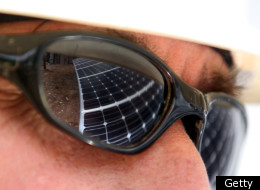
Poor Al Ritter: "I expected I would've had a bill that was over $300 for the month for electric power," Ritter told The Huffington Post. Instead, he said, his most recent bill came to $252 -- a savings he attributes to the array of 24 solar panels the Ritters had installed on their roof in August.
Like all people in TX, Ritter is used to wasting cheap carbon energy - his home wastes about 7200 Kw per month just trying to cool the 100 degree air. He built an a $30,000 PV Array on his roof, without insulating and air sealing his home. Now he gets about $60 off his energy bill each month.
If someone honest had sold him the solar panels, they would have required a home energy audit first, and that independen
$150/month X 12 = $1,800 / year on $10,000 -- >R.O.I. = 18% / year (FOREVER!)
$60/month X 12 = only $720 / year on $30,000 --> R.O.I. Just 2% / year (For 20-30 years)
Solar isn't a bad idea, but without first reducing you energy waste, it just doesn't work.
If Solar Installers keep doing this kind of bad business, they will kill their own industry as people wake up.
Read the Article at HuffingtonPost
Friday, September 23, 2011
A marshmallow for your thoughts?
Is "Self Control" at age four an indicator of intellect, the ability to reason, pattern recognition?
Read more at the New Yorker
Read more at the New Yorker
Once Mischel began analyzing the results, he noticed that low delayers, the children who rang the bell quickly, seemed more likely to have behavioral problems, both in school and at home. They got lower S.A.T. scores. They struggled in stressful situations, often had trouble paying attention, and found it difficult to maintain friendships. The child who could wait fifteen minutes had an S.A.T. score that was, on average, two hundred and ten points higher than that of the kid who could wait only thirty seconds.The scientists are hoping to identify the particular brain regions that allow some people to delay gratification and control their temper. They’re also conducting a variety of genetic tests, as they search for the hereditary characteristics that influence the ability to wait for a second marshmallow.
“What we’re really measuring with the marshmallows isn’t will power or self-control,” Mischel says. “It’s much more important than that. This task forces kids to find a way to make the situation work for them. They want the second marshmallow, but how can they get it? We can’t control the world, but we can control how we think about it.”
Brain Imaging
Gallant Lab website, with more details about the study
It seems via computer analysis and study of individual brain response to visual stimuli we can reconstruct a proximity of what the is in the minds eye. Many hurdles stand in the way of mind reading, not the least of which is that success requires years of brain scans while watching known video sources, and the tracking is done by blood volume rather than neuro-electrical signals, but the concept is still cool.
Read the Article from Berkley
Sunday, August 21, 2011
The Morality of Liberals Vs. Conservatives
Subscribe to:
Posts (Atom)